


Have you ever heard a "beep beep" sound coming from your computer speakers when your mobile phone receives an incoming call?
Or does the TV screen display static lines when a high-powered device like a hairdryer or blender is turned on nearby?
These are phenomena caused by electromagnetic interference (EMI).
In the modern world, where billions of electronic devices operate simultaneously, controlling electromagnetic interference has become a crucial requirement to ensure that devices can operate stably, safely, and without affecting each other.
This is why EMC (Electromagnetic Compatibility) has become one of the mandatory technical standards in the development and marketing of products.
1. The Nature of EMC: Concepts & Mechanisms
EMC (Electromagnetic Compatibility) is the ability of an electronic device or system to operate normally within its electromagnetic environment without causing electromagnetic interference exceeding acceptable levels for other surrounding devices.
EMC can be understood through two main issues:
-
- EMI (Electromagnetic Interference): The ability of a device to emit interference. An EMI-compliant device will not emit electromagnetic energy exceeding the threshold that affects other devices.
-
- EMS (Electromagnetic Susceptibility/Immunity): The ability of a device to withstand interference. An EMS-compliant device will operate stably and accurately even when attacked by external electromagnetic waves.
The core principle of EMC is that devices must both minimize interference to other devices and be able to withstand interference from the surrounding environment.
2. Common EMC Noise Sources and Transmission Pathways
All electromagnetic interference phenomena require three elements: a source of interference, a transmission path of interference, and a receiving device. Based on how interference energy travels, EMC is divided into two main groups:
Conducted Emission & Conducted Immunity
Interference can propagate directly through physical systems such as wires, power supply lines, or signal cables connecting devices:
-
- Voltage dips and interruptions: Sudden fluctuations in the power grid due to the switching on and off of large loads, which can easily cause microprocessor errors or power outages in sensitive equipment.
-
- Surges/Transients: High-voltage surges that occur for extremely short periods (e.g., due to indirect lightning strikes or current surges) that can damage semiconductor components inside a circuit.
-
- Harmonics: Generated by switching power supplies (SMPS) or industrial inverters, distorting the waveform of alternating current.
Radiated Emission & Radiated Immunity
Interference propagates unidirectionally as electromagnetic waves through space:
-
- Radio-frequency fields: Waves emitted from telecommunication stations, mobile phones, and Wi-Fi routers can inadvertently distort the small analog signal paths of sensor circuits.
-
- Electrostatic Discharge (ESD): The phenomenon of static electricity accumulating on a person's body or friction surfaces discharging directly into the casing, buttons, or connectors of a device, causing system freezes or permanent circuit damage.
3. Why are EMC testing mandatory for electronic devices?
In the era of booming wireless connectivity, EMC testing has become a critical juncture determining the survival of a technology product.
The travel permit is legally required.
EMC testing is not an optional requirement, but a legal requirement. You cannot bring a product to market without obtaining the necessary certifications.
-
- European Union (EU) market: CE Marking is mandatory, with compliance with the EMC Directive being a prerequisite.
-
- US market: Strictly regulated by the Federal Communications Commission (FCC) to ensure devices do not emit indiscriminate radio interference.
-
- Vietnamese market: Products must be tested and certified as compliant (CR) according to the National Technical Regulations (QCVN) of the Ministry of Information and Communications before being put into circulation.
Ensuring life safety and system security.
Imagine a medical device like a pacemaker malfunctioning due to interference from cell phone signals, or a car's electronic braking system (ABS) being incorrectly activated by weather radar. In fields such as healthcare, aviation, automotive, and industrial automation, even a minor EMC error can cost human lives.
Economic optimization problem
The modern electronics industry operates on the principle of strict cost optimization:
-
- Layout and circuit diagram design phase: If risks are detected and addressed immediately by adding filter capacitors, ferrite beads, or optimizing the wiring path (ground plane), the modification cost is almost zero.
-
- Prototype phase: If testing reveals errors, engineers will have to remake the printed circuit board (PCB), replace components, increasing costs by several thousand USD and delaying the project schedule.
-
- Mass production phase: If a product is flagged by regulatory authorities or is defective upon reaching consumers, the costs of recall, brand damage compensation, and complete overhaul of the production line can amount to millions of dollars.
4. Typical EMC Testing Items
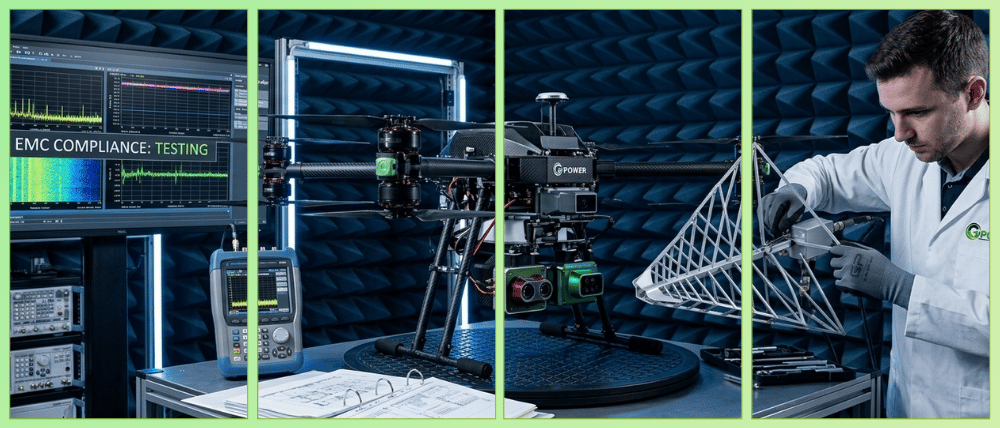
To obtain certification, the device must undergo a series of rigorous tests in a specialized laboratory (Anechoic Chamber):
|
Testing category |
Type of interference |
Evaluation objectives |
Typical standards |
|
Radiated Emissions |
Radiation (Emissions) |
Measure the amount of electromagnetic waves emitted into space by the device to ensure it remains below the permissible threshold. |
CISPR 32 / EN 55032A |
|
Conducted Emissions |
Transmission (Emission) |
Measure the amount of interference current from devices pushing back into the public power grid. |
CISPR 16 / FCC Part 15 |
|
Electrostatic Discharge (ESD) |
Radiation/Exposure (Interference Resistance) |
Test the device's ability to withstand electrostatic discharge (up to several kV). |
IEC 61000 -4-2 |
|
Radiated Immunity |
Radiation (Interference Resistance) |
Ensure the device operates stably when subjected to strong radio wave beams. |
IEC 61000-4-3 |
|
Surge Immunity |
Transmission (Interference Resistance) |
Assess the device's ability to survive high-voltage surges caused by lightning strikes. |
IEC 61000-4-5 |
5. Conclusion
An excellent electronic device is not just about powerful processing performance or a trendy design. It needs to be a stable and durable operating entity. Proactively investing in testing and optimizing EMC design is a strategic step to ensure the quality, safety, and commercial success of the product.
GPower Vietnam proudly offers comprehensive testing solutions and equipment—from destructive testing systems and silent chambers to advanced signal analysis equipment. We are ready to partner with your project to help you pass rigorous EMC tests and confidently bring your products to the global market. Contact us today for advice on the optimal testing solution for your business.


 Info@gpower.com.vn
