


This article analyzes why this sensor family has become the preferred choice for high-frequency impact, shock, and vibration testing in the aerospace and defense industries.
1. Specifics of aircraft impact testing
Aerospace and defense testing may include testing of escape seats, parachute systems, structural crash simulations, or evaluating the shock resistance of electronic equipment.
Compared to conventional NVH measurements, these tests have several characteristics that require special attention:
- - Extremely high acceleration in extremely short time: Impact pulses can reach thousands of grams in just a few milliseconds, requiring sensors to respond instantaneously without saturation or signal delay.
- - Very wide frequency range: Shock pulses contain high-frequency components up to tens of kHz, requiring sensors with sufficiently high resonant frequencies to avoid distorting the measurement signal.
- - Harsh environment: Large temperature fluctuations, humidity, high ground vibrations, and sometimes strong electromagnetic pulses from the detonator or pyrotechnic system during testing.
2. Why are Dytran sensors suitable for shock and impact measurement?
Designed for ultra-high acceleration measurement ranges.
Dytran accelerometers, specifically designed for impact testing, typically have a measurement range of up to tens of thousands of grams – far exceeding the range of conventional NVH accelerometers (only a few hundred grams). This allows the sensor to accurately record impact pulses without signal clipping, a crucial factor in aviation safety analysis.
High natural resonant frequency
Dytran sensors for impact/collision testing applications are designed with a very high resonant frequency, which minimizes post-pulse oscillations – a common error that distorts measurement data and makes accurate analysis difficult.
Mechanical strength and overload capacity
In real-world impact testing, sensors may be subjected to surges far exceeding their nominal range if unexpected events occur. Dytran sensors are renowned for their high overload tolerance, protecting data and equipment in unforeseen test scenarios.
Durable structure in harsh environments
Dytran's materials and mechanical design are optimized for stable operation under extreme temperature conditions and environments with strong electromagnetic pulses – common in tests involving pyrotechnic systems or detonation devices used in aerospace and defense testing.
3. Some notable Dytran accelerometer sensor models
3.1. Ultra-Miniature Triaxial IEPE Sensors
This is the core strength that has made Dytran famous. These sensors are designed for modal analysis or testing applications in extremely tight spaces without altering the object's mass.
- - Dytran 3023A Series : A classic mini 3-axis sensor series weighing only 3 grams . It uses a quartz sensing element housed in a laser-sealed titanium casing, providing maximum protection against moisture and dust.
- - Dytran 3333A1 : An improved, ultra-lightweight version weighing only 2.3 grams and measuring just 8.1 mm in height . This model uses a standard M4.5x0.35 connector (20% smaller than the industry standard), allowing for extremely flexible connection of ultra-thin cables.
- - Dytran 3263A Series : Weighing approximately 5.6 grams , it uses piezoelectric ceramic material combined with low-noise electronic circuitry, resulting in a very wide frequency response range.
3.2. Low-frequency sensor series & Structural monitoring
When it comes to measuring low-frequency vibrations in large structures, bridges, or for seismic surveys, Dytran designs sensor lines with extremely high sensitivity.
Dytran 3191 Series : A specialized industrial sensor series for monitoring building or bridge structures. The device stands out for its ability to capture very low-frequency vibrations, incorporating a fully insulated stainless steel housing and Faraday shielding to protect against electromagnetic interference.
3.3. High-temperature resistant sensor series
Suitable for harsh environments such as automotive exhaust systems, aircraft engines, turbines, or combustion chambers.
Dytran 3316M3 : A super-temperature resistant sensor series operating in electrostatic mode with a record-breaking operating temperature range from -51°C to +538°C . The sensor utilizes the company's proprietary silver window technology to ensure mechanical durability at high temperatures.
3.4. General Purpose Industrial Sensor Series
Dytran 3019 Series : An ideal single-axis sensor for measuring and monitoring vibrations in rotating machinery and high-frequency industrial motors.
3.5. Integrated vibration data logger
Dytran 4400A : This device is not only a 3-axis MEMS sensor but also a battery-powered data logger . The device is small in size and automatically records all acceleration/vibration data directly to an internal SD card without the need for a wired connection to a computer during measurement.
4. Applications of Dytran accelerometer sensors in aerospace and defense.
|
Type of test |
Specific measurement requirements |
The role of Dytran sensors |
|
Emergency escape chair/parachute testing |
Extremely high acceleration pulse, very short duration. |
Accurately record the amplitude and shape of the shock wave. |
|
Aircraft frame crash simulation (crash test) |
Multi-point measurement, wide frequency range |
Determine the acceleration distribution across the entire structure. |
|
Testing the emergency flare system. |
Strong electromagnetic pulse environment |
Stable measurement, low signal interference. |
|
Equipment durability testing in the cabin. |
Vibration and shock combined |
Assessing the durability of aviation electronics |
The specific sensor configuration should be selected based on pulse amplitude, pulse duration, the frequency range to be measured, temperature, and installation method.
4. Dytran's prominent accelerometer sensor lines
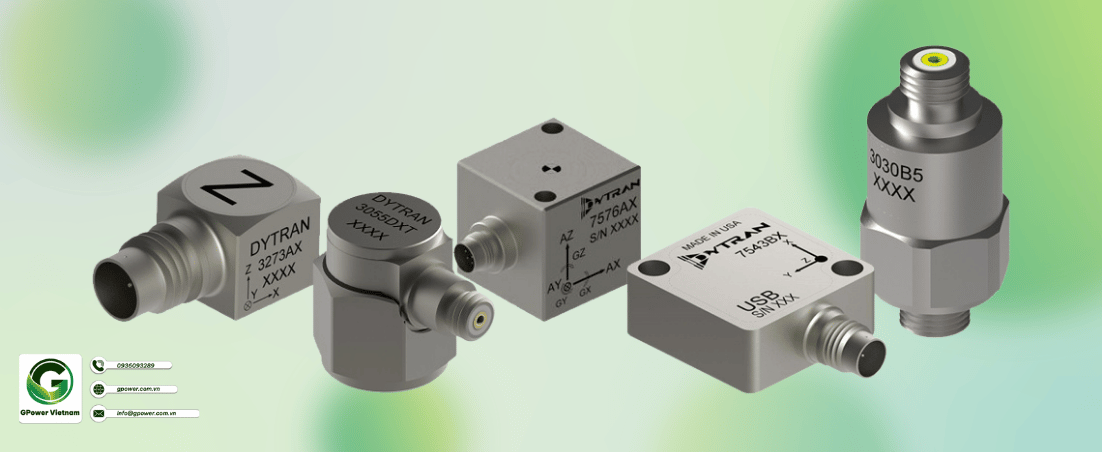
4.1. IEPE Accelerometers – IEPE Accelerometer Sensors
This is Dytran's most popular sensor line, featuring an integrated signal amplification circuit (IEPE), allowing direct connection to DAQ systems without the need for an external amplifier.
Key features:
- - Wide frequency range.
- - High sensitivity.
- - Good noise immunity.
- - Simple to install and use.
- - Compatible with modern data collection systems.
4.2. MEMS Accelerometers – MEMS Accelerometer Sensors
Using MEMS (Micro Electro Mechanical Systems) technology, this sensor series is suitable for measuring low-frequency vibrations or static acceleration.
Key features:
- - Both static and dynamic acceleration can be measured.
- - Compact size.
- - High stability.
- - Good impact resistance.
- - Low power consumption.
4.3. Triaxial Accelerometers – Three-axis accelerometer sensors
This allows simultaneous measurement of acceleration in three directions (X, Y, and Z) with just one sensor.
Key features:
- - Collect data simultaneously along three axes.
- - Reduces installation time.
- - High accuracy.
- - Saves space.
4.4. High Shock Accelerometers – Shock sensors
Designed to measure very large acceleration pulses over short periods of time.
Key features:
- - Measuring range up to tens of thousands of grams.
- - High frequency response.
- - Withstands strong impacts.
- - Robust design.
4.5. Miniature Accelerometers – Ultra-small accelerometer sensors
Their very small size and weight limit the sensor's impact on the object being measured.
Key features:
- - Extremely lightweight.
- - High sensitivity.
- - Wide frequency response.
- - Easy to install in tight spaces.
4.6. Charge Mode Accelerometers – Charge Output Sensors
This sensor series is specifically designed for high-temperature environments or harsh working conditions.
Key features:
- - Operates at high temperatures.
- - Wide frequency range.
- - Good stability.
- Suitable for in-depth measurements.
4.7. Automotive Test Accelerometers – Sensors for automotive testing
Dytran also develops a range of specialized sensors for the automotive industry, meeting international testing standards.
Key features:
- - High accuracy.
- - High resistance to vibration and shock.
- - Compact design.
- - Compatible with many DAQ systems.
GPower Vietnam - Partner providing aviation impact measurement solutions.
Given the demanding technical requirements of aviation impact testing, businesses need a partner who understands both the equipment and the real-world testing challenges. GPower Vietnam offers comprehensive partnership value:
- - Sensor selection advice: Identifying the correct Dytran accelerometer sensor suitable for each type of impact pulse and specific test conditions.
- - Supplier consultation: Direct connection with authorized suppliers, ensuring quality and clear origin for measuring equipment in the aerospace and defense industries.
- - Integrated solution consulting: Ensuring the sensor operates synchronously with the high-speed DAQ system, meeting the requirements for high-frequency pulse detection.
- - Calibration, warranty, and maintenance: Regular calibration services help sensors maintain accuracy through multiple testing cycles.
Contact GPower Vietnam today for advice on specialized impact sensor solutions for your aerospace and defense projects - Hotline: 0936093289 | Email: info@gpower.com.vn


 Info@gpower.com.vn
